

A. Kori Hill
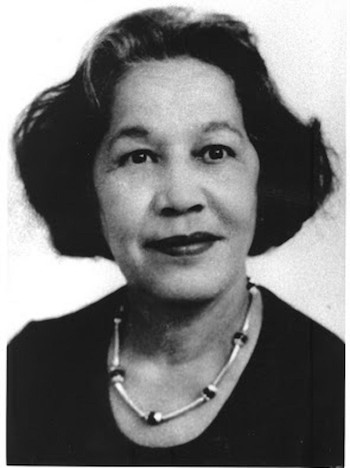
There are times when your dream isn’t derailed but postponed. That can happen for a variety of reasons. For Irene Britton Smith (1907–1999), it was because of money. She wanted to study music at Northwestern University, but her family didn’t have enough money to send her. She then attended the Chicago Normal School, where she studied to become a teacher. She would teach in the Chicago Public School system for forty years and even wrote a book about how to teach reading to kindergarteners!
And what else was she doing? She kept studying music and composing. In 1943, Irene graduated with a Bachelor of Music from the American Conservatory of Music in Chicago, where she studied with Stella Roberts and Leo Sowerby (fun fact: Florence Price had studied with Sowerby there too!).
During summer breaks and sabbaticals (that’s when a teacher gets several months off to do research), Irene studied compositions at big-name places and with big-name people: Nadia Boulanger at the American Conservatory in France, Vittorio Giannini at Juilliard, and Irving Fine at Tanglewood Music Festival. And while she was doing all that, she got her Master of Music degree from DePaul University in 1956.
One of her pieces she completed during this time was her Sonata for Violin and Piano. It is one of her most frequently performed and recorded pieces. Irene completed it in 1947, around the time she was studying with Giannini in New York City. The sonata has three movements – Allegro cantabile, Andante con sentimento, and Vivace.
Irene’s sonata is unique because instead of being driven by melody, it’s driven by contrapuntal motion. Contrapuntal motion is the name for the technique of integrating two independent lines into a cohesive whole. You hear this a lot in polyphonic textures.
Also, Irene plays with expectations of modulation and harmonic progression. The first movement, Allegro cantabile, starts in D-flat major, but it’s not too clear because Irene doesn’t start on the tonic; she starts on the supertonic!
In music theory, we represent the supertonic as ii, because if you stack the thirds starting on E-flat in the key of D-flat major, you get a series of minor thirds (E-flat, G-flat, B-flat). Play it on the keyboard and you’ll hear that it sounds a little sadder than when you play it with a G natural.
Irene develops this main theme and then modulates to the second theme, which is in the key of A major. This section is perky and dance-like. The falling 32nd note triplets are an ornamentation popular in romantic violin music in the 1940s. There are also moments where we slip into F# minor, which is the relative scale of A major.
We then move back to the opening theme, but this time in G major! This section is a mix of the first and second sections in terms of character, which leads us back to the recap and the return to D-flat major. But then Irene does something cool: she takes us back to the second, perky theme, this time in B flat major, and ends the movement in that section! So, in one movement, she’s taken us from D-flat major to A major to G major to D-flat major to B-flat major. This tells us that she’s playing with the standard harmonic progression as it’s taught in classical music: lots of I to V to I.
But here, instead of going to A flat major, which is V in D flat major, she goes to A major, which is technically sharp V. Then, she goes to G major, which is sharp IV in D-flat major (and D-flat major is flat V in G major).
B-flat major is IV in D-flat major, which makes for a smoother modulation sonically. But by moving from D-flat major to A major, Irene creates a color shift: the emotional quality of the sound. Listen to when the violin and piano move from D-flat major to A major. Yes, both are major keys, but does it sound happy in the beginning? Why or why not? This is a great movement to think about the ways you can use modulation, not for the sake of changing keys, but to use key changes to highlight specific moods and emotions you want to highlight in a specific area of your composition.
In Andante con sentimento, we once again return to D-flat major, moving to B-flat and back to D-flat. This movement is in 3/4 time and played in 1, so the feel is more dance-like and flowing. Vivace is in B-flat major and is the most dance-like of the movements. The rhythms are small and quick, with a few meter changes, but mostly staying in 2/4.
As you take a listen to this sonata, see if you can identify when she modulates outside of the key changes. When does she shift to F# minor in the A major section (hint, look for E#!)? Do you hear G minor in the B-flat major sections (Hint: Look for F#!)?


